What Is Carbonara? Complete Guide
Learn what carbonara is, its surprising modern origins, key ingredients, and how it differs from similar pasta dishes. Complete introduction to authentic Roman carbonara.
What Is Carbonara? Complete Guide
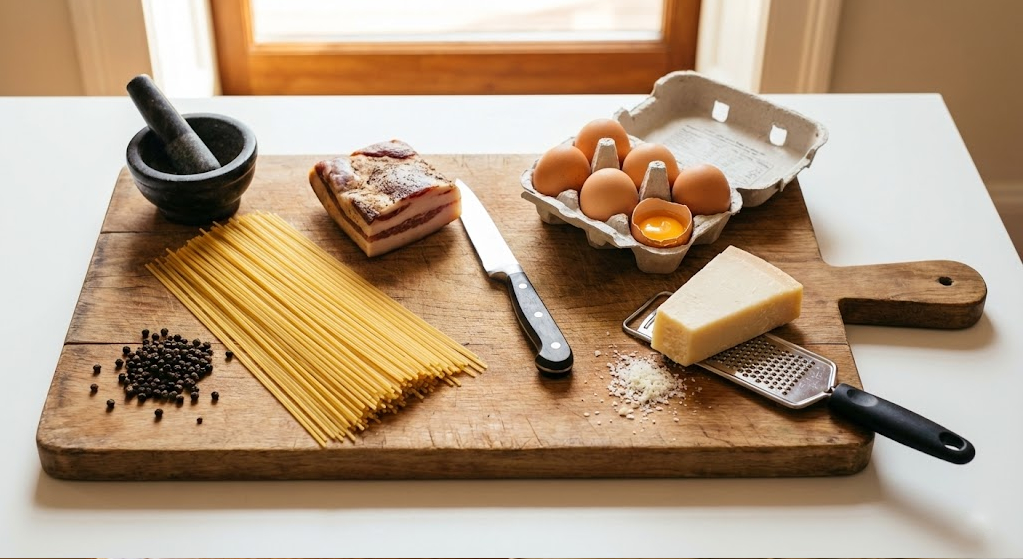
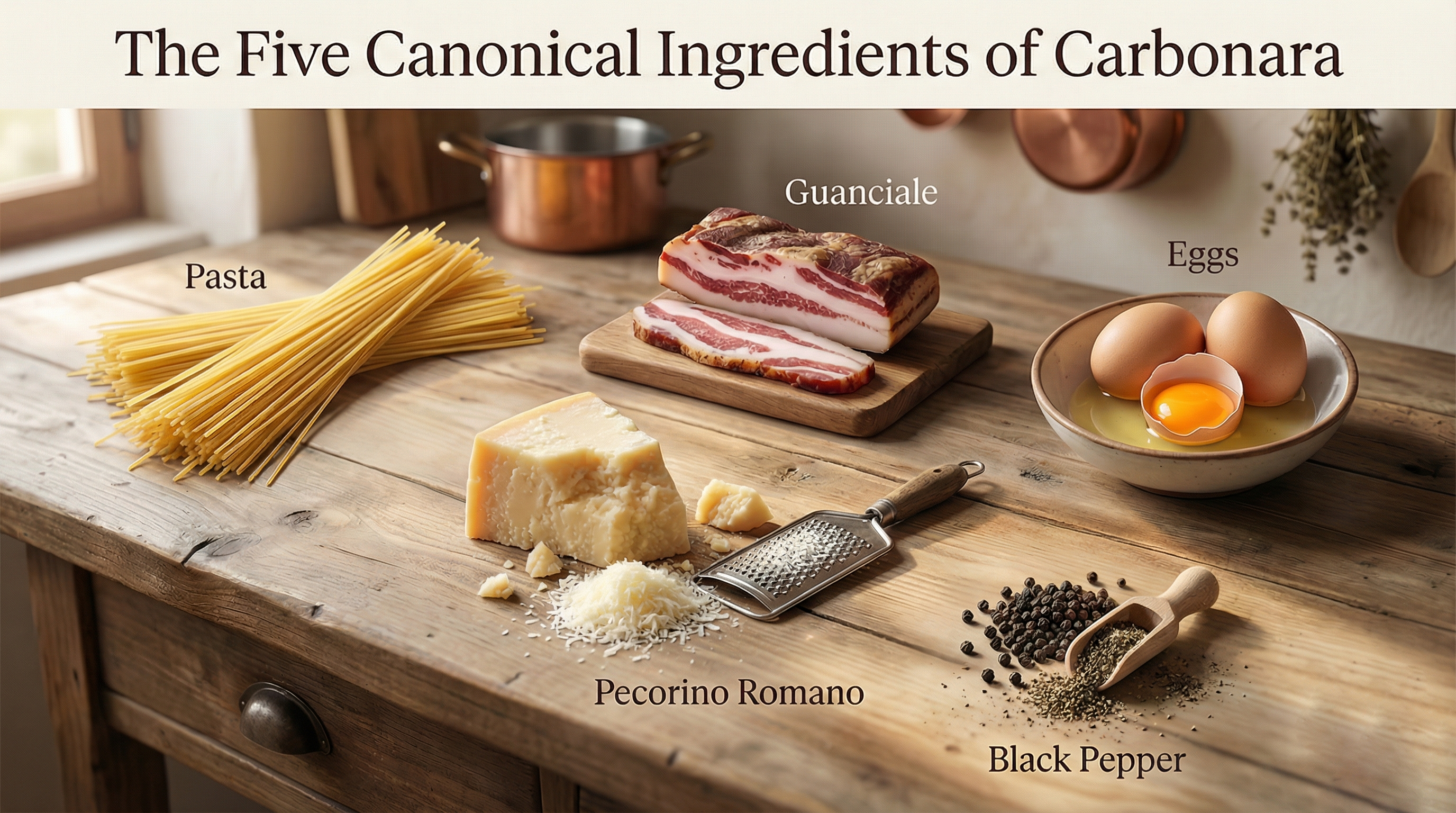
Carbonara is a classic Roman pasta dish made with just five ingredients: guanciale (cured pork jowl), egg yolks, Pecorino Romano cheese, black pepper, and pasta. Despite its reputation as an ancient Italian tradition, carbonara emerged only in the mid-1940s, making it surprisingly modern.
What Is Carbonara?
Carbonara is a creamy pasta dish from Rome that achieves its silky texture through emulsification—combining eggs, cheese, and starchy pasta water—not through cream. The sauce is created by vigorously tossing hot pasta with a mixture of eggs, freshly grated Pecorino Romano, rendered guanciale fat, and starchy pasta water.
The five essential ingredients:
- Pasta — Traditionally spaghetti, but rigatoni and mezze maniche also work
- Guanciale — Cured pork jowl (not bacon or pancetta)
- Egg yolks — Sometimes with whole eggs added
- Pecorino Romano — Sheep’s milk cheese, freshly grated
- Black pepper — Freshly cracked, generous amount
The Surprising Origins
Despite popular belief, carbonara is not an ancient Italian dish. The charcoal-worker origin story is romantic folklore with no historical evidence.
The actual timeline:
- 1930: Carbonara is conspicuously absent from Ada Boni’s comprehensive La Cucina Romana, which includes other Roman pastas like cacio e pepe, amatriciana, and gricia
- 1948: First documentary mention in Il Giornale di Trieste
- 1952: First published recipe in Chicago (Patricia Bronté’s Vittles and Vice)—not in Italy
- 1954: First Italian published recipe in La Cucina Italiana (notably used pancetta, Gruyère, and garlic—non-canonical ingredients)
- 1990s: Modern “authentic” recipe codified with only eggs, guanciale, Pecorino, pepper, and pasta
The most credible origin theory: Carbonara likely emerged after Rome’s liberation in June 1944, when American and British military rations (bacon, powdered eggs, cheese, cream) met Italian culinary ingenuity. Chef Renato Gualandi provided a detailed account of creating a similar dish in September 1944 using Allied rations.
Key Ingredients Explained
Guanciale (Cured Pork Jowl)
What it is: Cured pork jowl (cheek), aged at least three months
Why it matters:
- Highest fat content of the three options (guanciale, pancetta, bacon)
- Never smoked (unlike bacon)
- Rich, herbal flavor impossible to replicate
- The rendered fat forms the emulsion base
Substitution: Pancetta works if guanciale isn’t available, but guanciale is more authentic.
Pecorino Romano
What it is: Sheep’s milk cheese with DOP (Protected Designation of Origin) certification
Why it matters:
- Saltier, tangier than Parmigiano-Reggiano
- Essential for authentic carbonara flavor
- Must be freshly grated—pre-grated won’t emulsify properly
- Provides the salty backbone of the dish
DOP standards:
- 100% fresh sheep’s milk from designated regions
- Sardinia produces over 90%
- Minimum 5-8 month aging
- Lamb rennet
Eggs
The debate: Even in Italy, chefs disagree on whole eggs vs. yolks only.
Common approaches:
- Yolks only — Richer, creamier, more margin for error
- Whole eggs + yolks — Some chefs add whole eggs for easier handling
- Vincenzo’s Plate formula: 1 yolk + 30g Pecorino per 100g pasta, plus 1 whole egg added to total
Scientific rationale: Yolks contain lecithin (emulsifier) and coagulate at higher temperatures, providing more margin for error.
Black Pepper
Why it matters:
- Adds visual contrast (visible specks on finished dish)
- Provides aromatic heat
- Balances richness
Note: Some chefs, like Arcangelo Dandini, omit pepper entirely, believing its bitter note doesn’t suit the dish. This is controversial but demonstrates carbonara’s flexibility.
Pasta
Traditional shapes:
- Spaghetti — Most traditional
- Rigatoni — Tubes catch sauce inside
- Mezze Maniche — Roman favorite, shorter tubes
Quality matters: Bronze-die pasta has better sauce adherence than Teflon-die.
What Carbonara Never Contains
Every authoritative Italian source—the Accademia Italiana della Cucina, Gambero Rosso, and all respected Roman chefs—agrees on what’s forbidden:
❌ Cream — Absolutely forbidden in authentic carbonara
❌ Milk — Not needed, not traditional
❌ Butter — Not part of authentic recipe
❌ Garlic — Never in authentic carbonara
❌ Onion — Not traditional
❌ Parsley or herbs — Not part of authentic recipe
❌ Pre-grated cheese — Won’t emulsify properly
Historical note: While cream is now universally rejected, it was actually common in Italian carbonara recipes from the 1960s through 1980s. Even legendary chef Gualtiero Marchesi used cream in his 1989 recipe. The modern prohibition was codified in the 1990s.
How Carbonara Differs from Similar Pastas
Carbonara vs. Cacio e Pepe
Carbonara:
- Guanciale + eggs + Pecorino + pepper
- Creamy from egg emulsion
- More complex flavor
Cacio e Pepe:
- Only Pecorino + pepper + pasta
- Creamy from mantecatura technique
- Simpler, more focused flavor
Shared technique: Both use mantecatura (vigorous tossing) to create creaminess.
Carbonara vs. Alfredo
Carbonara:
- Eggs + cheese emulsion
- Guanciale for flavor
- No cream
- Roman origin
Alfredo:
- Butter + Parmigiano-Reggiano
- Cream often added (American version)
- No eggs
- Roman origin (different dish)
Carbonara vs. Pasta alla Gricia
Carbonara:
- Guanciale + eggs + Pecorino + pepper
- Egg-based sauce
Pasta alla Gricia:
- Guanciale + Pecorino (no eggs, no tomato)
- “White amatriciana”
- Simpler, no eggs
Connection: Gricia is like carbonara without eggs, or amatriciana without tomatoes.
Common Misconceptions
Misconception 1: Carbonara Is Ancient
Reality: Carbonara emerged in the mid-1940s, likely from Allied military rations. The modern “authentic” recipe was only codified in the 1990s.
Misconception 2: Cream Is Traditional
Reality: While cream was common in 1960s-1980s Italian recipes, modern authentic carbonara (codified 1990s) never contains cream.
Misconception 3: Any Pasta Works
Reality: While many shapes work, spaghetti, rigatoni, and mezze maniche are traditional. The shape affects sauce adherence and technique.
Misconception 4: Bacon Is Fine
Reality: Guanciale is traditional. Pancetta works as a substitute, but bacon’s smoke can overpower other flavors.
Misconception 5: Pre-Grated Cheese Works
Reality: Pre-grated cheese won’t emulsify properly. Fresh grating is essential.
The Science Behind Carbonara
Carbonara’s creamy texture comes from a carefully controlled emulsion:
- Egg yolks contain approximately 10% lecithin, a natural emulsifier
- Starchy pasta water provides the second emulsifier (amylose starch)
- Temperature control is crucial—eggs coagulate at 65°C (149°F)
- Vigorous tossing (mantecatura) creates the emulsion through motion
The technique: Fat from guanciale + starchy water + eggs + cheese, combined through vigorous tossing, creates a stable emulsion—similar to mayonnaise but with pasta as the canvas.
How to Make Carbonara
Basic Technique
- Render guanciale in a cold pan until fat is clear and meat is golden
- Cook pasta until al dente, reserving pasta water
- Prepare egg mixture (yolks, cheese, pepper)
- Temper eggs with hot pasta water
- Combine pasta with guanciale (pan off heat)
- Add egg mixture and toss vigorously
- Add pasta water as needed while tossing
- Serve immediately
Key principles:
- Pan must be off heat before adding eggs
- Toss vigorously (don’t stir)
- Work quickly
- Serve immediately
Frequently Asked Questions
Is carbonara Italian?
Yes, carbonara is Italian, specifically Roman. However, it’s surprisingly modern—emerging in the mid-1940s, not ancient times.
Why is carbonara so popular?
Carbonara combines simplicity (5 ingredients) with technique, creating a dish that’s both accessible and impressive. Its creamy texture and rich flavor make it universally appealing.
Can I make carbonara ahead of time?
No, carbonara must be served immediately. The sauce continues thickening as it cools, and the texture changes.
Is carbonara healthy?
Carbonara is rich and indulgent—high in fat and calories. It’s a treat, not an everyday meal. A typical serving has 600-700 calories.
Why did my carbonara scramble?
Scrambled eggs happen when the pan is too hot. Always remove the pan from heat before adding eggs, wait for sizzling to stop, and temper eggs with hot pasta water first.
Can I freeze carbonara?
Not recommended. The egg-based sauce doesn’t freeze well and becomes grainy when thawed.
Related Content
- Authentic Roman Carbonara Guide — Complete deep dive
- Classic Spaghetti Carbonara Recipe — Step-by-step recipe
- Easy Carbonara Recipe — Beginner-friendly version
- Carbonara Without Cream — Why cream isn’t needed
- Best Guanciale to Buy — Ingredient guide
- Best Pecorino Romano — Cheese guide
Sources:
- Luca Cesari, A Brief History of Pasta — Historical research
- Accademia Italiana della Cucina — Authentic recipe definition
- Historical recipes and documentation