How to Temper Eggs for Carbonara (Prevent Scrambling)
Learn how to temper eggs for carbonara to prevent scrambling. Step-by-step technique with temperature science and troubleshooting tips.
How to Temper Eggs for Carbonara (Prevent Scrambling)
Tempering eggs is the key technique that prevents scrambled eggs in carbonara. By gradually warming the eggs with hot pasta water before adding them to the hot pasta, you create a stable, creamy sauce instead of scrambled eggs.
Why Tempering Prevents Scrambling
The problem: Adding cold eggs directly to hot pasta causes them to coagulate instantly, creating scrambled eggs instead of a creamy sauce.
The solution: Tempering gradually raises the eggs’ temperature, allowing them to cook gently and create a smooth emulsion.
The science:
- Egg yolks begin coagulating at 65°C (149°F)
- When diluted with pasta water, this threshold rises to approximately 80-85°C
- Tempering brings eggs closer to this temperature gradually
- The pan’s residual heat, combined with hot pasta, gently cooks the eggs without reaching coagulation temperature
Step-by-Step Tempering Technique
Step 1: Prepare the Egg Mixture
In a bowl (plastic or ceramic, not metal), whisk together:
- Egg yolks (and whole eggs if using)
- Freshly grated Pecorino Romano
- Generous black pepper
Whisk until smooth and well combined. The mixture should be at room temperature.
Why room temperature: Cold eggs are more likely to cause temperature shock when combined with hot pasta.
Step 2: Cook the Pasta and Reserve Water
Cook your pasta until al dente. Before draining, reserve at least 1 cup of hot pasta water.
Why starchy water matters: The starch in pasta water helps stabilize the emulsion and provides a buffer against temperature shock.
Step 3: Temper the Eggs (The Critical Step)
This is where most people go wrong. Here’s the correct technique:
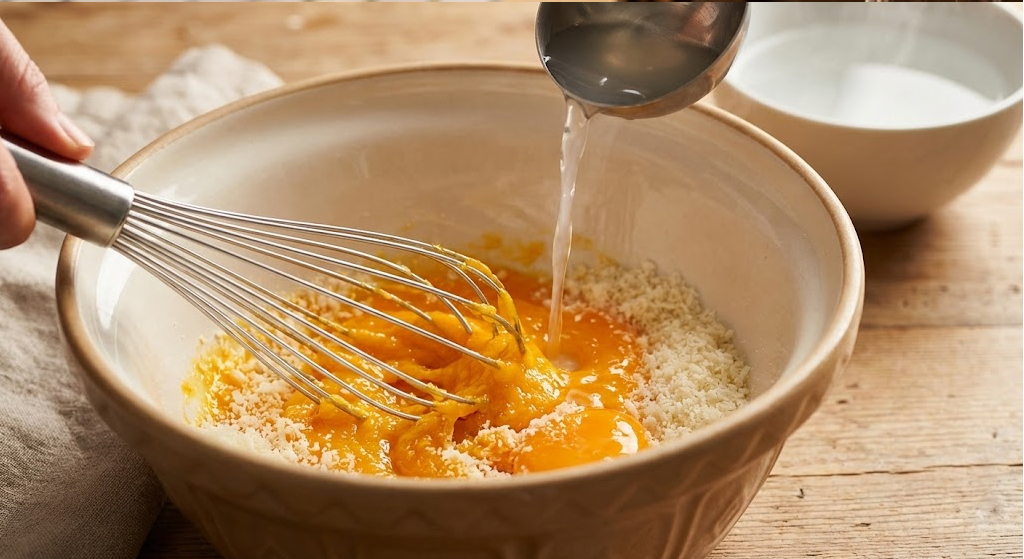
- Take 2-3 tablespoons of hot pasta water from your reserved cup
- Whisk it into the egg mixture quickly and continuously
- The mixture should become slightly warm and slightly looser
- Continue whisking until smooth
Visual cues:
- The mixture should look slightly warmer (steam may be visible)
- It should be slightly more liquid (not thick and pasty)
- No visible cooked egg pieces
Common mistake: Adding too much pasta water at once. Start with 2-3 tablespoons, whisk, then add more if needed.
Step 4: Combine with Pasta (Off Heat)
Critical: The pan must be completely off heat before adding the egg mixture.
- Remove pan from heat (if it was on)
- Wait 30 seconds — you should see the sizzling stop
- Add the hot pasta to the pan with guanciale
- Toss to coat with the rendered fat
- Add the tempered egg mixture over the pasta
- Toss vigorously for 30-40 seconds
- Add more pasta water gradually while continuing to toss
Why this works:
- The pan’s residual heat is warm, not hot
- The tempered eggs are already partially warmed
- The hot pasta provides gentle heat
- The combination stays below 65°C, preventing coagulation
Temperature Science Explained
Egg Coagulation Points
Pure egg yolks:
- Begin coagulating at 65°C (149°F)
- Fully set at 70°C (158°F)
Egg yolks diluted with pasta water:
- Coagulation threshold rises to 80-85°C
- Provides larger margin for error
- Allows gentle cooking without scrambling
Why tempering helps:
- Brings eggs from room temperature (~20°C) to ~40-50°C gradually
- Reduces temperature shock when combining
- Creates a more stable emulsion
- Prevents sudden coagulation
The Temperature Window
Safe zone: Below 65°C (for pure yolks) or 80°C (for diluted yolks)
Danger zone: Above these temperatures, eggs will scramble
Goal: Keep everything in the safe zone while achieving a custardy consistency.
Visual Cues: How to Know It’s Working
✅ Good Signs
- Sauce becomes creamy and glossy — Not watery, not pasty
- No visible scrambled egg pieces — Smooth, uniform texture
- Pasta is well-coated — Sauce clings evenly
- Silky texture — Smooth, not grainy
- Glossy sheen — Indicates proper emulsion
❌ Warning Signs
- Visible white streaks — Egg whites cooking separately
- Grainy texture — Eggs beginning to scramble
- Watery sauce — Not enough tossing or too much water
- Greasy appearance — Emulsion breaking
Common Mistakes and How to Fix Them
Mistake 1: Not Tempering at All
Problem: Adding eggs directly to hot pasta
Result: Instant scrambling
Fix: Always temper eggs with hot pasta water first
Mistake 2: Tempering with Cold Water
Problem: Using cold water instead of hot pasta water
Result: Doesn’t help, eggs still scramble
Fix: Always use hot pasta water (at least 80°C)
Mistake 3: Adding Too Much Pasta Water at Once
Problem: Dumping 1/2 cup of water into eggs
Result: May cause temperature shock or make mixture too thin
Fix: Add 2-3 tablespoons at a time, whisking continuously
Mistake 4: Pan Still on Heat
Problem: Adding eggs to pan that’s still on burner
Result: Eggs scramble immediately
Fix: Always remove pan from heat, wait for sizzling to stop
Mistake 5: Not Waiting Long Enough
Problem: Adding eggs immediately after removing from heat
Result: Pan is still too hot
Fix: Wait 30 seconds for pan to cool slightly
Mistake 6: Using Metal Bowl
Problem: Metal bowls conduct heat, can get too hot
Result: Eggs may start cooking in the bowl
Fix: Use plastic or ceramic bowl
Troubleshooting
My Eggs Still Scrambled
Immediate fix:
- Add cold pasta water immediately to stop cooking
- Toss vigorously
- The damage may be irreversible, but you can try to salvage
Prevention for next time:
- Temper eggs properly
- Ensure pan is off heat
- Wait longer before adding eggs
- Use more pasta water in tempering
My Sauce Is Too Thin
Problem: Too much pasta water or not enough tossing
Fix:
- Toss more vigorously (motion creates emulsion)
- Add more cheese if needed
- Use less pasta water next time
My Sauce Is Too Thick
Problem: Not enough pasta water
Fix:
- Add hot pasta water, 1 tablespoon at a time
- Toss while adding
- Continue until desired consistency
My Sauce Broke (Greasy)
Problem: Emulsion failure
Fix:
- Add splash of hot pasta water
- Toss vigorously
- The starch should help re-emulsify
Advanced Technique: Double Tempering
Some chefs use a “double tempering” technique:
- First temper: Add 2 tablespoons hot pasta water, whisk
- Second temper: Add 2 more tablespoons, whisk again
- Then combine with pasta
Why it works: Gradual temperature increase reduces risk of shock.
Pro Tips
- Have everything ready — Tempering requires quick action
- Use hot pasta water — At least 80°C, straight from the pot
- Whisk continuously — Don’t stop while adding water
- Start small — 2-3 tablespoons first, then add more if needed
- Work quickly — Have pasta ready before you start tempering
- Room temperature eggs — Take eggs out 30 minutes before cooking
- Plastic or ceramic bowl — Better insulation than metal
Temperature Control Checklist
Before adding eggs, verify:
- Pan is completely off heat
- Sizzling has stopped (waited 30 seconds)
- Eggs are tempered with hot pasta water
- Pasta water is hot (at least 80°C)
- Everything is ready (no last-minute searching)
Frequently Asked Questions
How much pasta water should I use for tempering?
Start with 2-3 tablespoons of hot pasta water. Whisk it in, then add more if needed. The total amount depends on your recipe, but start small.
Can I temper eggs ahead of time?
No, temper eggs immediately before combining with pasta. If you wait, the eggs may cool down and the tempering effect is lost.
What if I don’t have enough pasta water?
Always reserve at least 1 cup before draining. If you run out, you can use very hot tap water, but starchy pasta water is better.
Why does my carbonara always scramble?
Most likely causes:
- Pan is too hot (not removed from heat)
- Not tempering eggs properly
- Adding eggs too quickly
- Not waiting for pan to cool
Can I use a different method to prevent scrambling?
Some chefs use a bain-marie method (like Monosilio at 60°C), but tempering with pasta water is the standard home cook technique.
What temperature should the pan be?
The pan should be warm, not hot—around 50-60°C. You should be able to touch it briefly without burning. If it’s too hot to touch, it’s too hot for eggs.
The Bottom Line
Tempering is essential for preventing scrambled eggs in carbonara. The technique is simple but critical:
- Whisk 2-3 tablespoons hot pasta water into egg mixture
- Ensure pan is off heat and cooled slightly
- Combine and toss vigorously
- Add more pasta water as needed
The key: Gradual temperature increase prevents sudden coagulation. Master this technique, and you’ll never have scrambled carbonara again.
Related Content
- Why Carbonara Scrambles (And How to Fix It) — Detailed troubleshooting
- Authentic Roman Carbonara Guide — Complete recipe with tempering
- Easy Carbonara Recipe — Simplified technique
- The Science of Pasta Water — Why starchy water matters
Sources:
- Temperature science: Egg coagulation at 65°C
- Compass artifact: 2-3 tablespoons hot pasta water tempering method
- Chef techniques and best practices