Carbonara vs Alfredo: What's the Difference?
Complete comparison of carbonara and alfredo sauce. Learn the differences in ingredients, technique, origin, and when to use each. No more confusion!
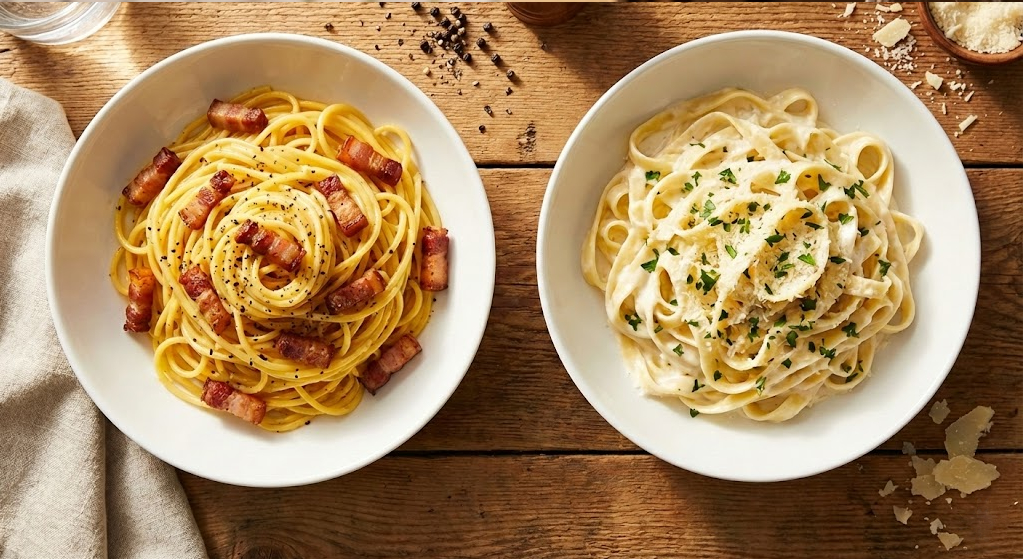
Carbonara vs Alfredo: What’s the Difference?
Carbonara and alfredo are both creamy Italian pasta sauces, but they’re completely different dishes with distinct ingredients, techniques, and origins. Understanding these differences helps you choose the right sauce and appreciate each dish’s unique character.
Quick Answer
Carbonara: Egg-based sauce with guanciale/pancetta, Pecorino Romano, black pepper, and pasta water. No cream. Roman origin.
Alfredo: Butter and Parmigiano-Reggiano sauce, often with cream added. Roman origin but popularized in America.
Key difference: Carbonara uses eggs for creaminess; alfredo uses butter (and often cream). Carbonara includes cured pork; alfredo is typically vegetarian.
At a Glance
| Factor | Carbonara | Alfredo |
|---|---|---|
| Base | Eggs + cheese + pasta water | Butter + cheese (+ cream) |
| Meat | Guanciale or pancetta (required) | None (typically) |
| Cheese | Pecorino Romano | Parmigiano-Reggiano |
| Cream | Never (authentic) | Often (American version) |
| Technique | Egg emulsion | Butter emulsion |
| Origin | Rome, Italy | Rome, Italy (butter version) |
| Color | Yellow/golden | White/cream |
| Flavor | Rich, porky, peppery | Rich, buttery, cheesy |
| Texture | Silky, creamy | Smooth, velvety |
| Difficulty | Medium (tempering eggs) | Easy (melting butter) |
What Is Carbonara?
Carbonara is a Roman pasta dish made with eggs, guanciale (cured pork jowl), Pecorino Romano, black pepper, and pasta water. The creaminess comes from emulsifying eggs with hot pasta water—no cream is used.
Characteristics
Ingredients:
- Eggs (yolks + whole eggs)
- Guanciale or pancetta
- Pecorino Romano
- Black pepper
- Pasta water
Technique:
- Eggs are tempered with hot pasta water
- Combined off heat to prevent scrambling
- Creates silky emulsion
Flavor Profile:
- Rich and porky (from guanciale)
- Salty (from Pecorino)
- Peppery (black pepper is key)
- Deep, savory umami
Origin:
- Rome, Italy (mid-20th century)
- Possibly created for American soldiers
- Now a Roman classic
Key Point: Authentic carbonara never contains cream. The creaminess comes from the egg emulsion.
What Is Alfredo?
Alfredo is a pasta sauce made with butter and Parmigiano-Reggiano. The original Roman version (Fettuccine Alfredo) was just butter and cheese, but American versions often add cream.
Characteristics
Ingredients (Original):
- Butter
- Parmigiano-Reggiano
- Pasta water
Ingredients (American Version):
- Butter
- Heavy cream
- Parmigiano-Reggiano
- Garlic (often added)
Technique:
- Melt butter
- Add cheese gradually
- Toss with pasta
- Add pasta water if needed
Flavor Profile:
- Rich and buttery
- Cheesy (Parmigiano)
- Mild and creamy
- Less complex than carbonara
Origin:
- Rome, Italy (early 20th century)
- Created by Alfredo di Lelio
- Popularized in America (with cream added)
Key Point: Original alfredo was just butter and cheese. American versions add cream, which changes the texture and flavor.
Key Differences
1. Base Ingredient
Carbonara:
- Uses eggs as the base
- Eggs create the creamy emulsion
- No cream (authentic)
Alfredo:
- Uses butter as the base
- Butter creates the creamy emulsion
- Often includes cream (American version)
Why it matters: Eggs require careful tempering; butter is simpler to work with.
2. Meat Content
Carbonara:
- Always includes meat (guanciale or pancetta)
- Meat is essential to the dish
- Provides fat for the emulsion
Alfredo:
- No meat (typically vegetarian)
- Can add chicken or shrimp (American variations)
- Original version is meat-free
Why it matters: Carbonara is not vegetarian; alfredo can be.
3. Cheese Type
Carbonara:
- Uses Pecorino Romano
- Salty, sharp, sheep’s milk cheese
- Essential for authentic flavor
Alfredo:
- Uses Parmigiano-Reggiano
- Nutty, sweet, cow’s milk cheese
- Melts smoothly with butter
Why it matters: Different cheeses create different flavor profiles.
4. Technique Difficulty
Carbonara:
- Medium difficulty
- Requires tempering eggs
- Must work off heat
- Risk of scrambling eggs
Alfredo:
- Easy
- Just melt butter
- Add cheese gradually
- Less risk of mistakes
Why it matters: Carbonara requires more skill; alfredo is beginner-friendly.
5. Flavor Complexity
Carbonara:
- Complex, layered flavors
- Porky richness from guanciale
- Salty sharpness from Pecorino
- Peppery heat
- Deep umami
Alfredo:
- Simple, straightforward
- Buttery richness
- Cheesy flavor
- Mild and creamy
- Less complex
Why it matters: Carbonara has more depth; alfredo is more straightforward.
6. Color
Carbonara:
- Yellow/golden (from egg yolks)
- Rich, warm color
- Opaque
Alfredo:
- White/cream (from butter/cream)
- Pale, light color
- Can be translucent (original) or opaque (with cream)
Why it matters: Visual difference is obvious—carbonara is golden; alfredo is pale.
When to Use Each
Use Carbonara When:
- You want authentic Roman pasta
- You have guanciale or pancetta available
- You want complex, layered flavors
- You’re comfortable with tempering eggs
- You want a meat-based dish
Best for: Special occasions, when you want authentic Italian, when you have quality ingredients.
Use Alfredo When:
- You want simple, creamy pasta
- You need a vegetarian option
- You want easy technique
- You’re cooking for beginners
- You want mild, comforting flavors
Best for: Weeknight dinners, picky eaters, when you want something simple and satisfying.
Can You Substitute One for the Other?
Can You Make Carbonara Without Eggs?
No. Eggs are essential to carbonara. Without eggs, it’s not carbonara—it becomes a different dish (pasta with guanciale and cheese).
Can You Make Alfredo Without Butter?
No. Butter is essential to alfredo. Without butter, it’s not alfredo—it becomes a different dish (pasta with cheese).
Can You Add Cream to Carbonara?
Not in authentic carbonara. Adding cream changes it from carbonara to “creamy pasta with guanciale.” The egg emulsion provides the creaminess—cream isn’t needed and changes the character.
Can You Add Meat to Alfredo?
Yes, but it’s not traditional. American versions often add chicken or shrimp to alfredo, but the original Roman version is meat-free.
Common Confusions
”Creamy Carbonara” with Cream
Mistake: Adding cream to carbonara.
Reality: Authentic carbonara doesn’t use cream. If cream is added, it’s not carbonara—it’s a creamy pasta dish inspired by carbonara.
Why it happens: People think carbonara needs cream for creaminess, but eggs provide that.
”Alfredo Carbonara”
Mistake: Combining both sauces.
Reality: These are separate dishes. You can’t really combine them—they have different bases (eggs vs. butter).
Why it happens: Both are creamy Italian sauces, so people think they can be combined.
Using the Wrong Cheese
Mistake: Using Parmigiano in carbonara or Pecorino in alfredo.
Reality:
- Carbonara needs Pecorino Romano (salty, sharp)
- Alfredo needs Parmigiano-Reggiano (nutty, sweet)
Why it matters: Different cheeses create different flavor profiles. Substituting changes the dish.
Recipe Comparison
Carbonara Recipe (Simplified)
- Render guanciale in cold pan
- Cook pasta, reserve pasta water
- Whisk eggs + Pecorino + pepper
- Combine pasta with guanciale (off heat)
- Add egg mixture, toss vigorously
- Add pasta water as needed
- Serve immediately
Key: Eggs create creaminess; no cream.
Alfredo Recipe (Simplified)
- Melt butter in pan
- Cook pasta, reserve pasta water
- Add pasta to butter
- Add Parmigiano gradually, tossing
- Add pasta water as needed
- (Optional: Add cream)
- Serve immediately
Key: Butter creates creaminess; eggs not used.
Frequently Asked Questions
Which is more authentic?
Both are authentic Italian dishes, but carbonara is more strictly defined. Alfredo has been adapted more in America (with cream added).
Which is healthier?
Neither is particularly healthy, but carbonara has more protein (from eggs and guanciale). Alfredo is higher in fat (butter/cream).
Which is easier to make?
Alfredo is easier—just melt butter and add cheese. Carbonara requires tempering eggs, which is trickier.
Can I make carbonara vegetarian?
Not authentic carbonara—guanciale is essential. But you can make vegetarian adaptations (see our Vegetarian Carbonara Recipe).
Can I make alfredo without cream?
Yes! Original alfredo was just butter and cheese. Cream is an American addition.
Which pasta shape works best?
- Carbonara: Traditionally spaghetti, but works with many shapes
- Alfredo: Traditionally fettuccine, but works with many shapes
Can I freeze either?
Neither freezes well:
- Carbonara: Eggs don’t freeze well
- Alfredo: Butter/cream can separate
Which is more popular?
In America, alfredo is more popular (easier, more familiar). In Italy, carbonara is more popular (authentic Roman dish).
The Verdict
Carbonara and alfredo are completely different dishes:
- Carbonara: Egg-based, includes meat, complex flavors, medium difficulty
- Alfredo: Butter-based, no meat, simple flavors, easy technique
Both are delicious, but serve different purposes:
- Choose carbonara when you want authentic Roman pasta with complex flavors
- Choose alfredo when you want simple, creamy pasta that’s easy to make
Don’t confuse them: They’re not interchangeable. Each has its place, and each is delicious in its own right.
Related Content
- Classic Spaghetti Carbonara — Authentic carbonara recipe
- Easy Carbonara Recipe — Simplified carbonara
- What Is Carbonara? — Complete carbonara guide
- Authentic Roman Carbonara Guide — Deep dive into carbonara
Sources:
- Traditional Italian cooking techniques
- Historical documentation of both dishes
- Comparison of authentic vs. American versions